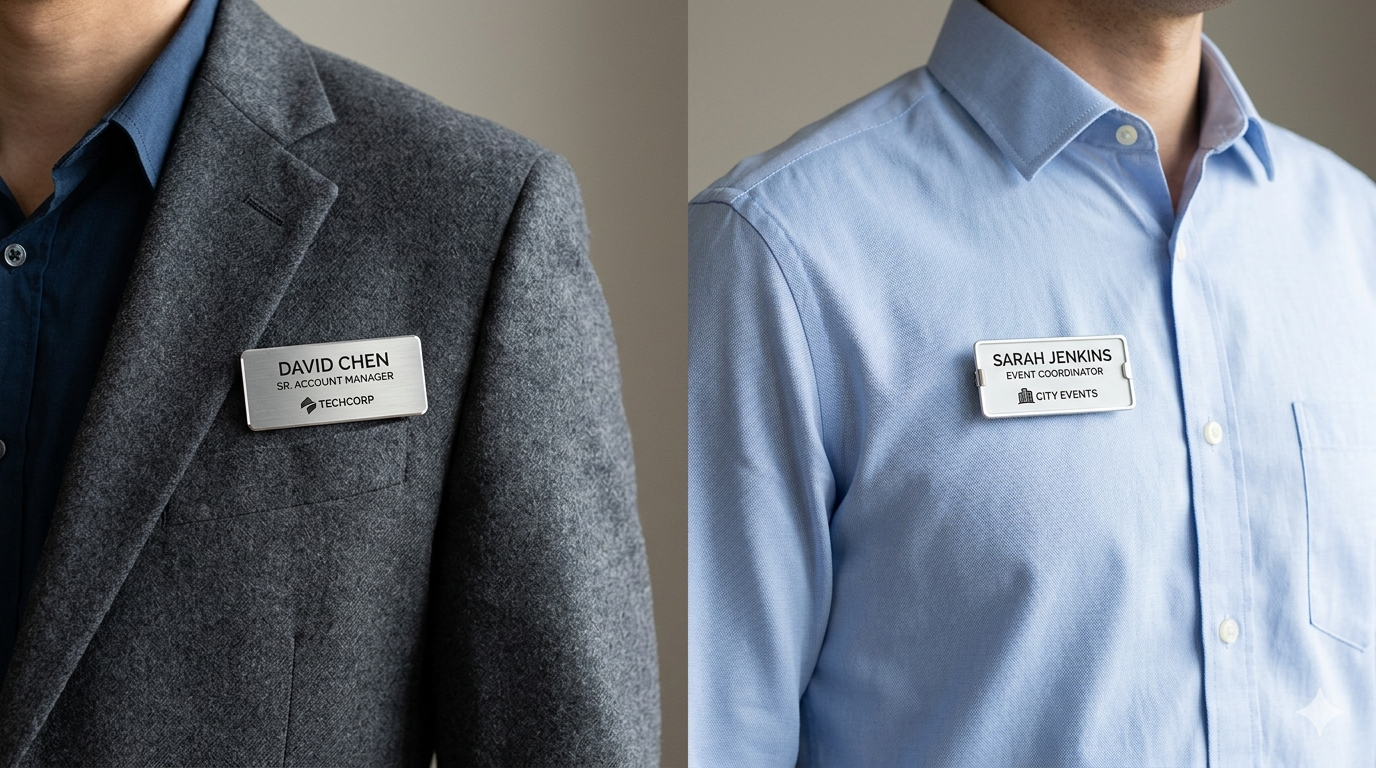

Walk into any hotel lobby, hospital reception desk, or large retail store and you’ll see name tags everywhere. Look closer at the back of any shirt and you’ll learn something about how the company thinks about its team. Pin clasps tear holes in shirts. Magnets don’t. The cost difference between the two is small. The difference in what they signal is bigger.
The case for pin clasps
Pins win on three things: they’re the cheapest option (under a dollar per backing), they don’t fall off when bumped (the closure is mechanical), and they work on any fabric thickness. For one-time conferences, short-term events, and venues where the tag is reissued daily, pins are the practical answer.
Where pins fall apart
The shirt. Pin holes accumulate. Polo shirts and uniform tops with a year of daily pinning end up with a constellation of holes around the upper-left chest. Front-of-house staff who care about how they look notice this. Hotels with daily-laundered uniforms eat the replacement cost in their linen budget. The tag is cheap; the destruction it causes isn’t.
The case for magnets
Magnetic backings clip on without piercing the fabric. They cost roughly $1.50 to $3 per backing depending on strength. They work on collared shirts, blouses, jackets, and most uniforms — anything that isn’t impossibly thick or made of magnet-shielding fabric. The same magnet backing lasts for years and gets reused as staff turn over (the tag insert changes; the magnet stays).
Where magnets fall apart
Heavy outerwear (winter coats, thick aprons, certain chef whites) where the fabric is too thick for the magnet to grip. Pacemakers — magnets are not allowed near them, so any team member with a cardiac device should use an alternative. Active jobs with hard collisions (warehouse, construction) where the magnet can shake loose.
The math
For a team of 25 wearing tags daily, pins cost about $25 in backings plus about $400 a year in shirt-damage replacement (estimate: 1 polo per person per year at $16). Magnets cost about $50 in backings up front, last 3+ years, and add zero shirt damage. By month 6 the magnets have paid for themselves; by year 2 you’re well ahead.
The signal
The honest reason most polished operations choose magnets isn’t the math. It’s that magnets signal a kind of care. The team isn’t poking holes in their own shirts. The tags don’t look bent and crooked. The whole operation looks intentional. For customer-facing teams in hospitality, healthcare, and retail, that signal is worth the extra dollar per tag on its own.
What to specify when you order
Confirm: magnet strength (standard or heavy-duty), insert size (3×1, 3×1.5, or custom), printing method (full-color sublimation handles logos and gradients best), and whether you want changeable inserts (so the same magnet works for new hires) or fixed-print (one tag per person, replaced when staff turns over).