Name Badges for Healthcare & Hospitality Teams
Few industries lean on name badges harder than healthcare and hospitality. In a hospital corridor, healthcare name badges are part of the care experience: patients recovering from anesthesia, families under stress, and colleagues from other units all need to know instantly who someone is and what they do. In a hotel or restaurant, the badge is a service cue that invites guests to use a name and sets the tone for the interaction. The two industries share a need for durable, legible identification — but the details that make healthcare name badges work differ meaningfully from what a front-desk team needs. This guide covers both, from role-title conventions and readability distances to sanitization, fasteners, and ordering systems that survive turnover.
What Both Industries Get Wrong First
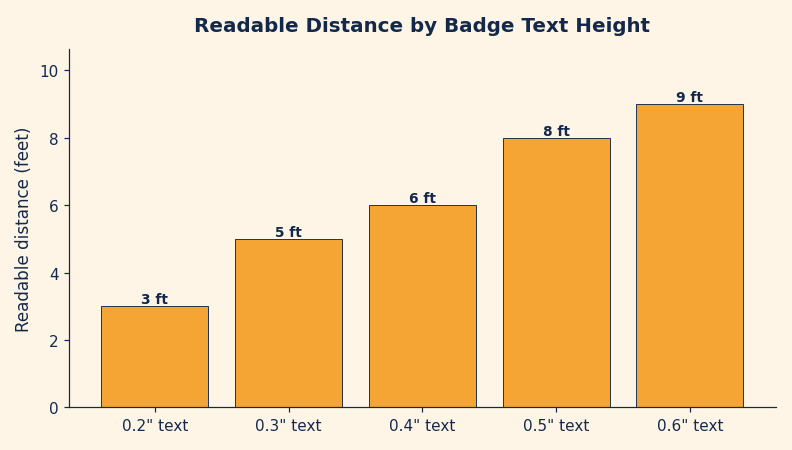
The most common badge mistake in both settings is the same: text too small to read at a natural distance. A badge works when a patient in a bed or a guest across a counter can read the first name without leaning in — that means roughly 4 to 6 feet. At that distance, a first name needs to be set at least 0.4 inches tall (roughly 28–36 pt), which immediately argues for a first-name-forward layout: big first name, smaller last name or initial, and a clear role line beneath.
Healthcare Name Badges: Compliance Meets Compassion
Role titles are often required
Many U.S. states require hospital and clinic staff to display their licensure or role — RN, LPN, CNA, MD, PA — and several specify minimum letter sizes for the credential. Even where law is silent, accreditation surveyors and hospital policy usually demand it. The safe pattern: credential in bold beneath the name, in text nearly as large as the name itself, because patients genuinely use it to know who is treating them.
Sanitization drives material choice
Hospital name badges get wiped with alcohol and quaternary disinfectants daily. Cheap surface prints dull and ghost within months of that regimen. Specify engraved text or UV-printed graphics under a sealed coat on metal or high-grade plastic, and choose a smooth face without crevices where residue collects. Brushed aluminum with engraved lettering is a proven performer in clinical settings.
Magnets, pins, and clinical reality
Magnetic fasteners protect scrubs and cardigans from pin holes and let staff re-seat a badge one-handed between tasks. One important caution belongs in every healthcare badge policy: magnetic backers are not recommended for staff with implanted cardiac devices, so keep a small stock of pin or clip alternates and note the option on your order. For roles that also carry RFID access cards, consider a badge layout that visually distinguishes the ID badge from the name badge so patients are not squinting at a barcode.
Antimicrobial and shift-proof extras
Antimicrobial coatings are a reasonable upgrade in acute care, though they supplement — never replace — wipe-downs. For night-shift units, a white or light badge face outperforms dark faces under dimmed corridor lighting.
Hospitality Name Tags: The Badge as a Service Tool
First names sell service
Hospitality name tags almost universally drop last names — “Maria” invites conversation; “M. Gonzalez-Herrera” reads like paperwork. Add hometown or language lines (“Speaks French & Arabic”) where your guest mix rewards it; they are proven conversation starters at front desks and on cruise-style service teams.
Finish signals brand tier
A polished gold badge on a navy blazer says luxury hotel; a matte black badge with white type says modern bistro. Match badge finish to your interior palette the way you would match fixtures. Where healthcare optimizes for sanitization, hospitality optimizes for polish — badges here are jewelry with a job.
Role titles work differently
In hospitality, role title badges are about routing requests: “Concierge,” “Sommelier,” “Guest Services Manager” tell guests who can solve which problem. Titles matter most for supervisory and specialist roles; line staff often carry name-only badges to keep the guest interaction personal rather than hierarchical.
| Requirement | Healthcare | Hospitality |
|---|---|---|
| Name format | First name + credential (RN, MD, CNA) | First name only, large |
| Role title | Often legally required, bold | Optional; used for routing (Concierge, Manager) |
| Material priority | Sanitizer-proof: engraved metal or sealed print | Finish-matched metal: gold, silver, matte |
| Fastener | Magnetic, with pin alternates for pacemaker wearers | Magnetic standard (protects uniforms) |
| Extras | Antimicrobial coat, light face for night shifts | Language lines, hometown lines |
| Typical replacement cycle | 18–30 months | 12–24 months (turnover-driven) |
Surviving Turnover: The Ordering System Matters More Than the Badge
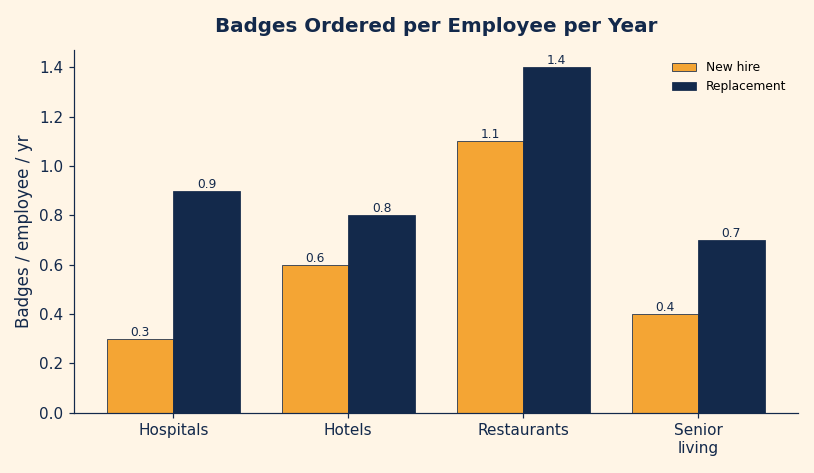
Hospitality turnover routinely exceeds 70% a year, and healthcare support roles are not far behind. The badge program that works is the one that keeps up with onboarding:
- Standardize one template per brand: one size, one layout, one finish per property or unit, so every reorder matches the wall of badges that came before it.
- Keep a live roster file: reorders become a five-minute email instead of a design project.
- Batch monthly: a standing monthly reorder for new hires beats emergency one-offs on price and consistency.
- Choose reorder-friendly marking: engraved metal reorders match perfectly years later; printed batches can drift in color if your supplier changes processes — another reason to keep the logo simple and the spec documented.
- Consider insert frames for the highest-churn roles: seasonal banquet staff can be badged in-house same-day, while core staff wear permanent badges.
Recommended Specs by Setting
- Hospital / clinic: 3 x 1.5 in brushed aluminum, engraved first name at 0.45 in, bold credential line, magnetic backer with pin alternates, light face color.
- Upscale hotel: 3 x 1 in gold- or silver-finish metal matched to fixtures, engraved first name, optional title for supervisors, three-magnet bar for blazers.
- Restaurant / café: 2.75 x 1 in matte metal or framed insert, first name only, magnetic backer.
- Senior living: largest text of all — 0.5 in+ first name, high-contrast face, role line for care staff.
For a deeper look at the metal, finish, and engraving choices behind these specs, read our companion guide to metal name tags. You can browse badge styles at magneticnametag.com, learn about our process on the about page, or find more team-badging guides on the blog.
The Bottom Line
Great healthcare name badges are readable from the bedside, sanitizer-proof, credential-forward, and safe around medical devices. Great hospitality badges are first-name-forward, finish-matched to the brand, and cheap to keep current through turnover. Both start with one decision: a documented, standardized template your team can reorder without thinking.
Badging a care team or a front-of-house staff?
Magnetic name badges built for sanitizer, turnover, and brand polish — with low minimums.